
FlosFerri
«Historical reenactment, medieval fencing and Renaissance dances.»
The Company
The Flos Ferri association was founded in 2001 by Gianluca Falcone and Marco Signorini, who, after some years of solitary practice of the art of Medieval Fencing, decided to share their passion with anyone interested in this discipline.
The group mainly deals with the reconstruction of fencing techniques, studied through historical documents and manuals that treat the art of war in the period from the end of the 13th century to the beginning of the 15th century, with particular attention to the Italian school of the famous magistro Fiore Dei Liberi. The company is inspired by the mercenary soldiers, infantrymen and knights present in Ravenna at the end of the 14th century in the service of Lord Guido Da Polenta.
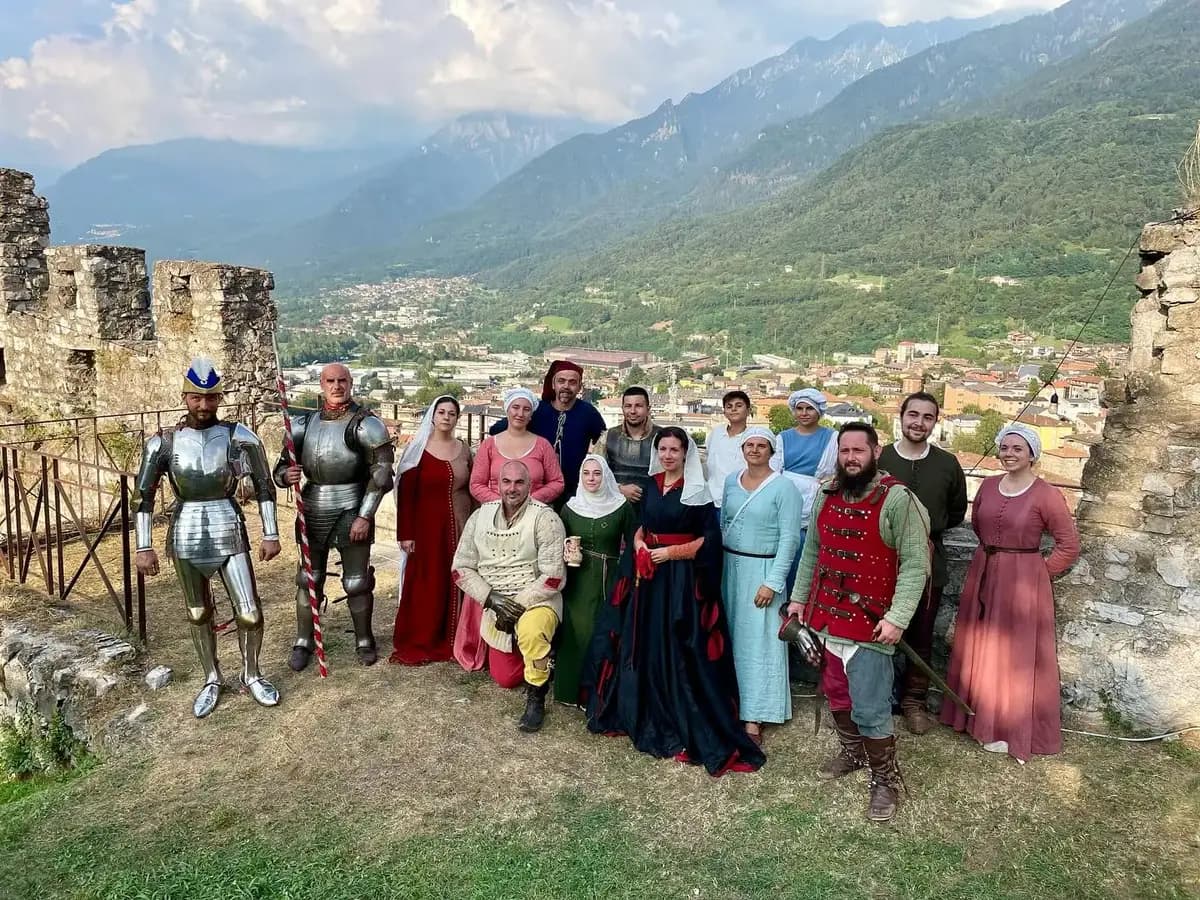
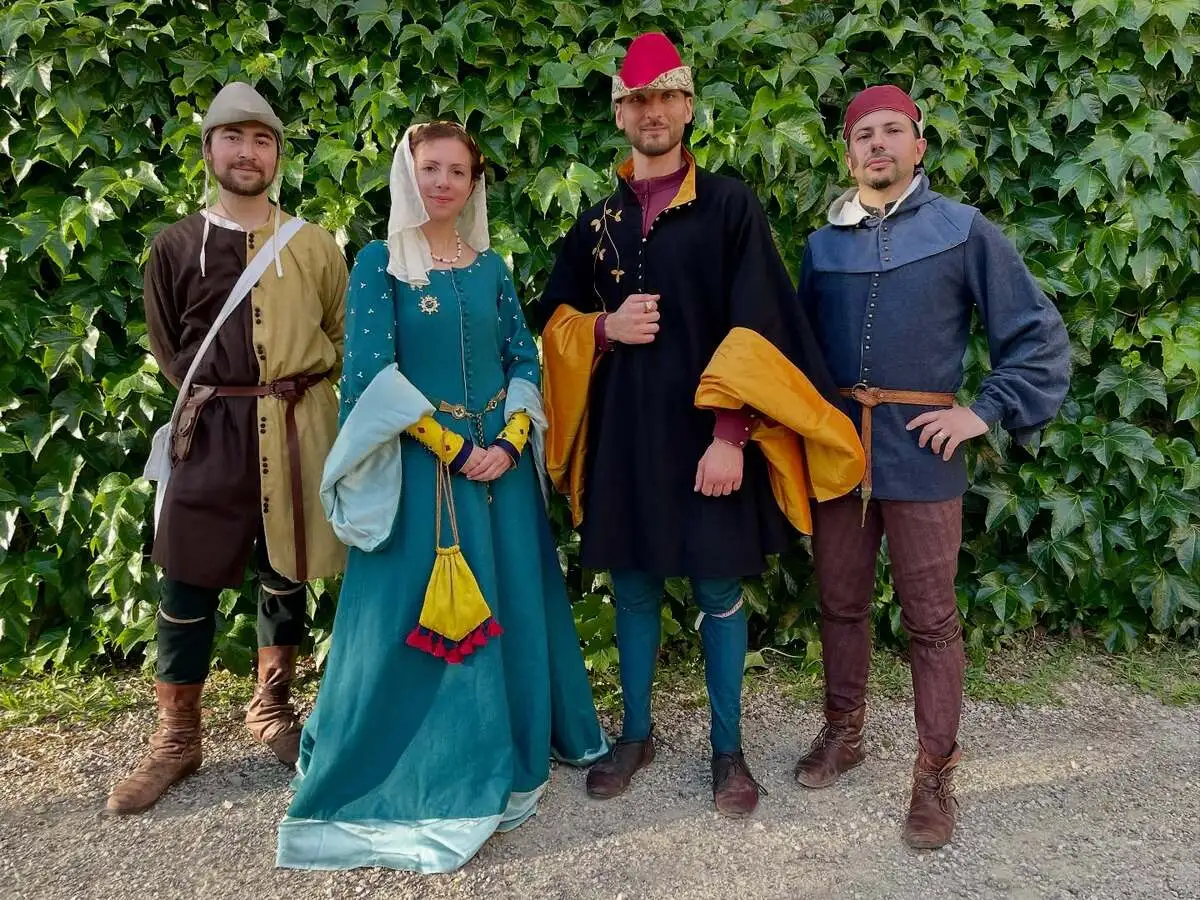
Combat practice is divided between training and public performances. The latter are completed by historical reconstruction and dissemination activities, which revolve around the camp, functional as well as vital for our group. Besides being rewarding and fun for us, and bringing many young people closer to culture and history through the exercise of fencing, combat is an opportunity to arouse interest and attract the public into a short journey through time that can touch on the most disparate aspects of medieval life. Over the years, the group's activities have evolved to include the study of historical sources and their reproduction for educational purposes for the public. Everything used by us, starting from the clothes to the tools or armor, is, in fact, a replica as faithful as possible to the finds that have come down to us. For this reason, since 2024, the Flos Ferri association has been established as an A.P.S., reflecting its natural evolution towards historical reenactment in its broadest facets over the years.
Thus, the members of the association passionately study and illustrate, with historical sources in hand, medieval board, dice and strategy games, the art of cosmetics, medieval cooking recipes, and restore and repair weapons and armor using period techniques. Moving with our camp, we have the opportunity to reenact battles and perform dances during festivals and ceremonies held in the villages of Italy. All our activities, as well as costumes, weapons, tools and the camp itself, are reconstructed based on research conducted on sources of the time, on university studies and treatises and on dedicated publications. All these efforts then materialize in the short space of a duel or a dance, in the long hours spent making objects and accessories, and in the selection of the best reproductions of original artifacts to add to our collection.
The audience only has to let themselves be transported on a journey through time, whether it is to find a few minutes of escape or to fill the most unusual curiosities. The important thing is that it is a moment of aggregation, sharing, and fun for everyone!
Medieval Fencing
Born as a group of armed men, the main activity of Flos Ferri is the study of the techniques and martial arts of the period, ranging from the end of the 13th to the beginning of the 15th century. These have come down to us thanks to the work of great masters or anonymous people who immortalised on parchment the countless techniques for coming out alive from a battle, a duel, or, more simply, a street brawl.
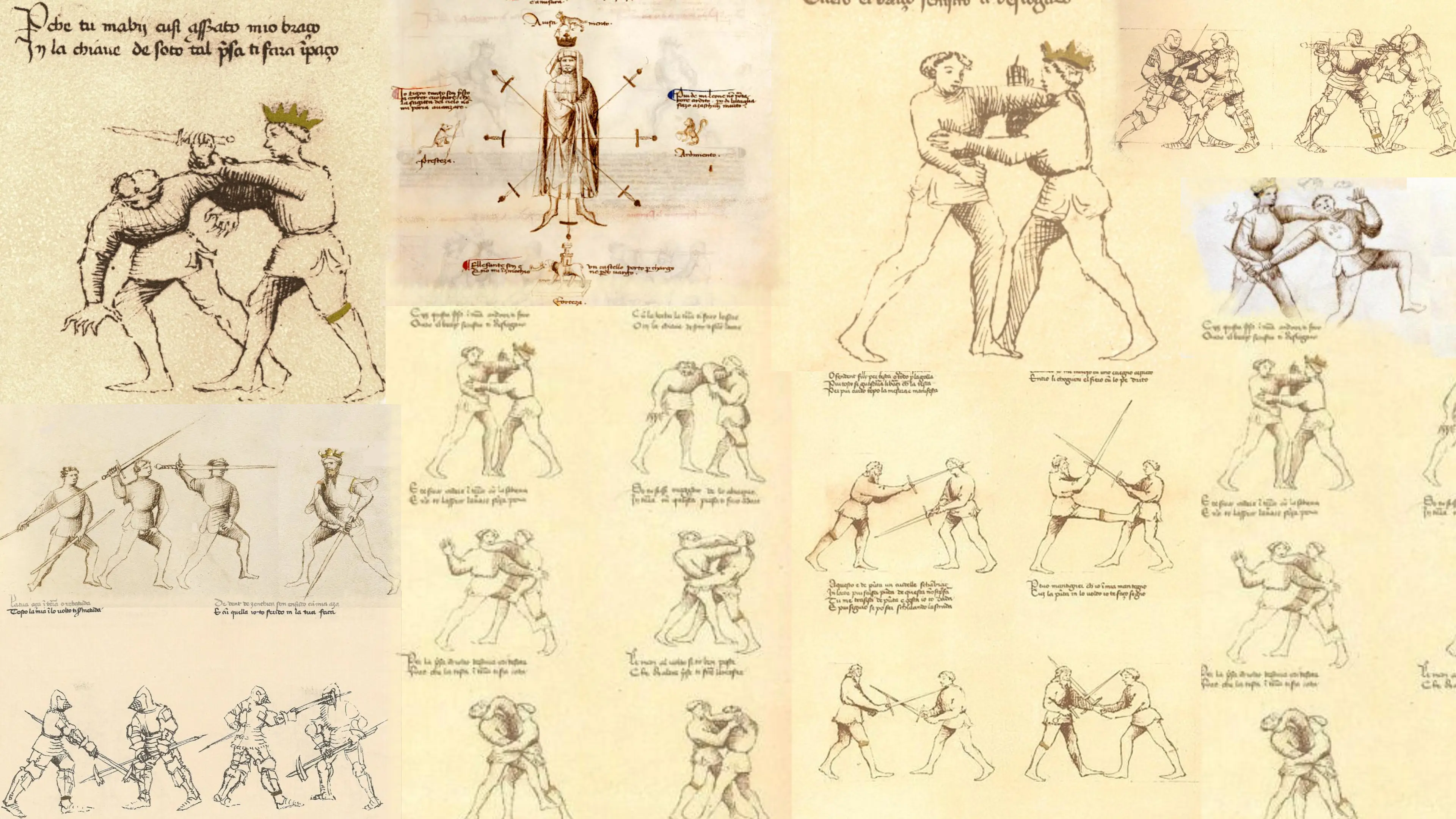
The main treatises on which we base our fencing are the I33 and the Flos Duellatorum, in homage to whose author – Fiore de’ Liberi – the name of our company was born.
Unfortunately, the documentation that has come down to us does not explain in detail how the men of the time fought, so this is where our reconstruction and research work begins. Through the analysis of the treatises, practice, and the study of weapons and armour, we try to understand what the principles were that formed the basis of a real martial art, which has nothing to envy the most celebrated Eastern techniques.
All this work, which proceeds year by year, materialises in the few minutes of a duel or in the most hectic phases of a pitched battle, giving us the satisfaction of having given our best and being rewarded by applause or the admiration of the spectators.
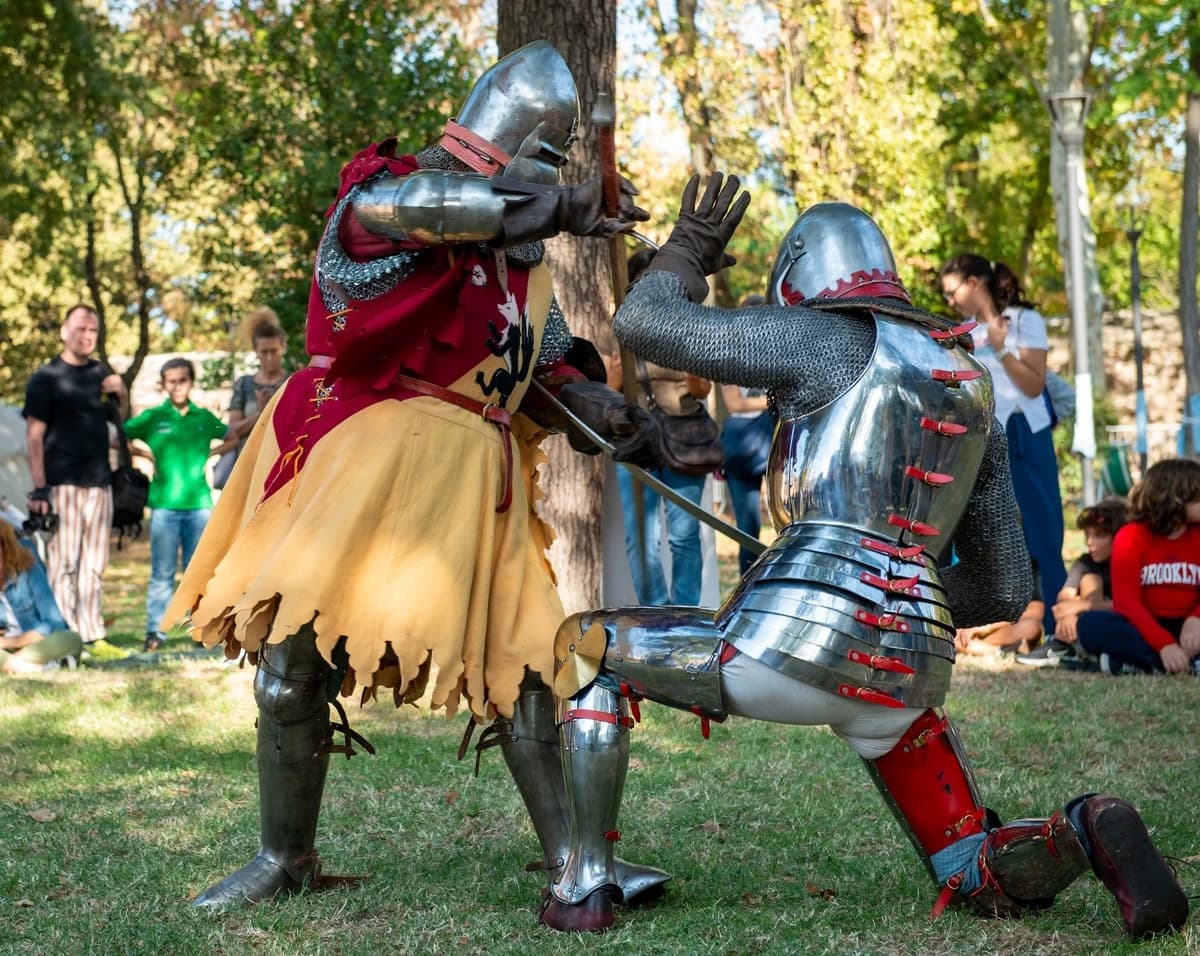
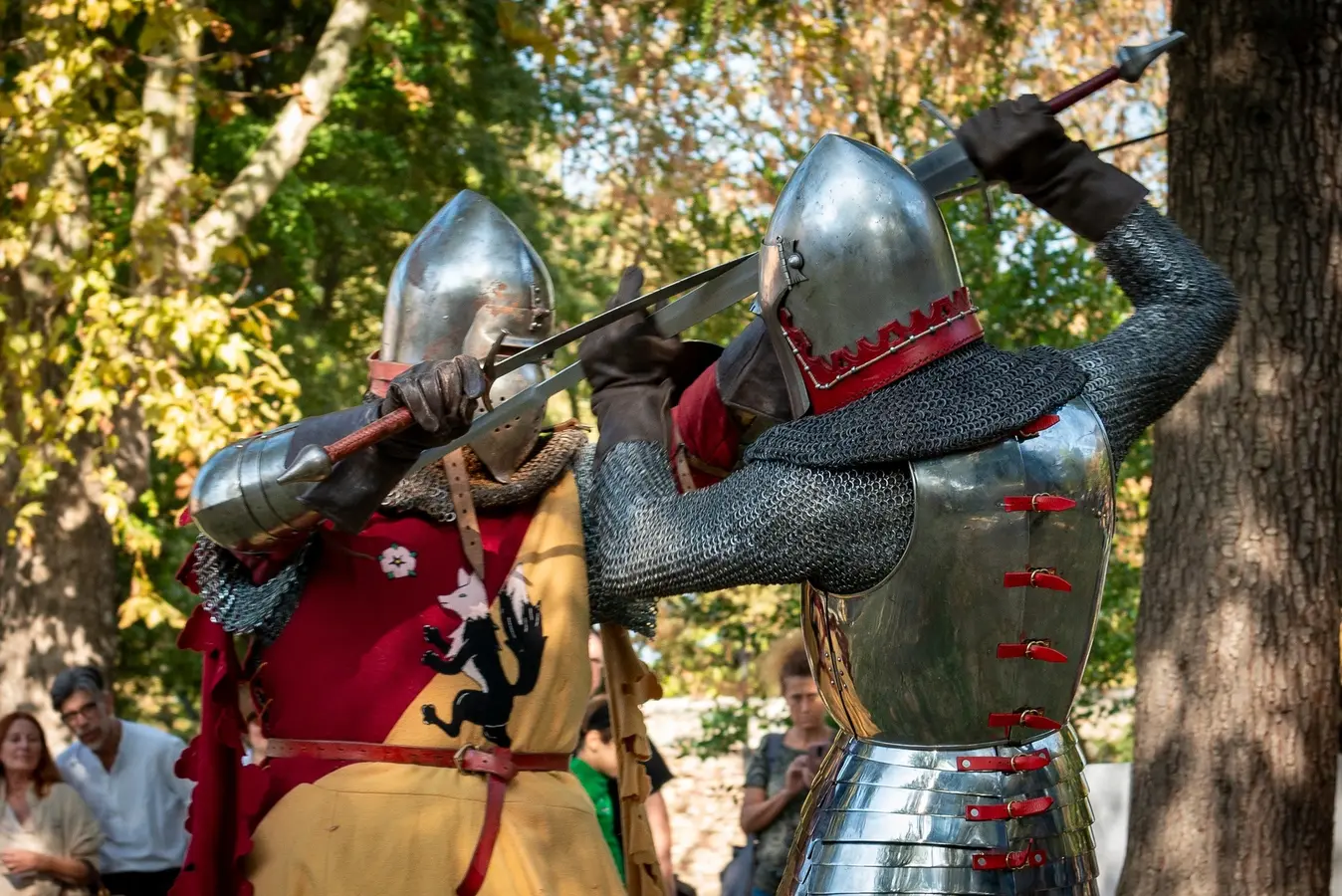
Our fights are not choreographed or agreed upon for mere spectacularity, but are the result of training that allows us to recreate realistic duels, while maintaining adequate levels of safety thanks to the mastery of the weapons used. Another aspect we focus on a lot in our performances is emphasizing how physical and instinctive the way of fighting of the man-at-arms of the 14th century was, compared to the 'hall' fencing that spread in the following centuries outside the lists and battlefields.
For this reason, we easily pass from sword and buckler to the dagger, from the poleaxe to the longsword, even if the clashes often end in wrestling: grappling, takedowns, and locks, exactly as suggested by the miniatures of the Flos Duellatorum and other treatises intended for the warrior elite of the time.
Events
If you want to come and meet us in person, here is a list of upcoming scheduled events:
The Camp
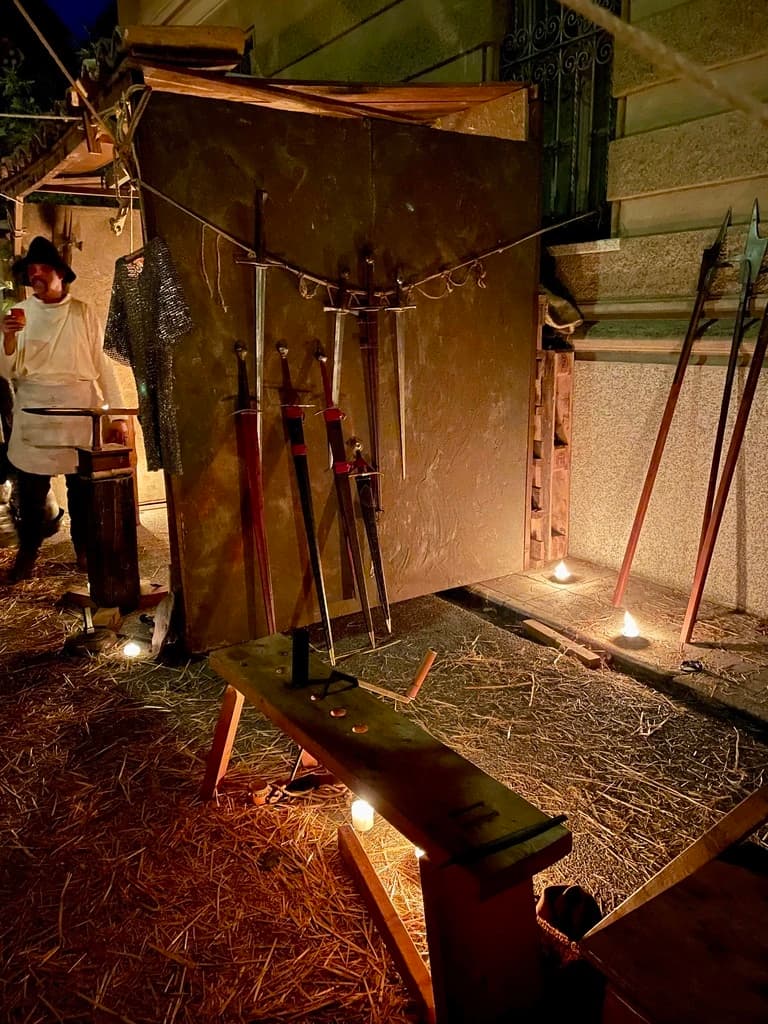
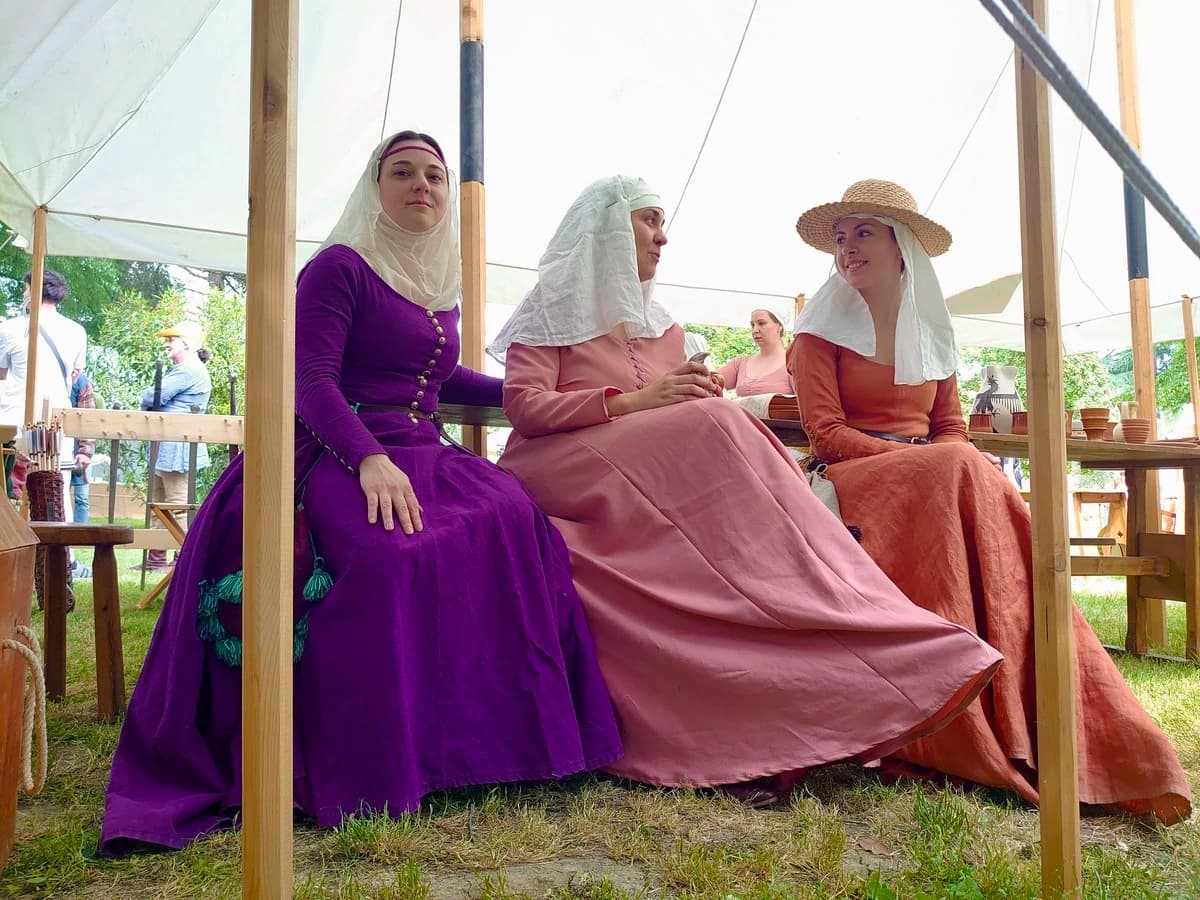
The camp is the hub around which all the group's activities rotate: it is therefore not surprising that it is continuously expanding or updating. Furthermore, being our home for the entire duration of the outings, it is easy to find it in disorder (contrary to what one might think, this is something we are proud of). In fact, the camp is not simply a background or a set, it is a real support for daily life and every part of it is designed with a purpose: the awnings protect us from the sun and light rain, the tents shield us from the humidity of the night and summer storms, the tables and benches become a canteen where we serve food prepared in our kitchen and a meeting point after a day of work, and finally, the racks collect weapons and armor so that they are always visible and accessible to the public. It is for this reason that our camp will never be perfect, but at the same time, it appears very real and welcoming, designed time after time to welcome the public and put them in a position to see, feel, and touch everything they desire with their own hands.
Renaissance Dances
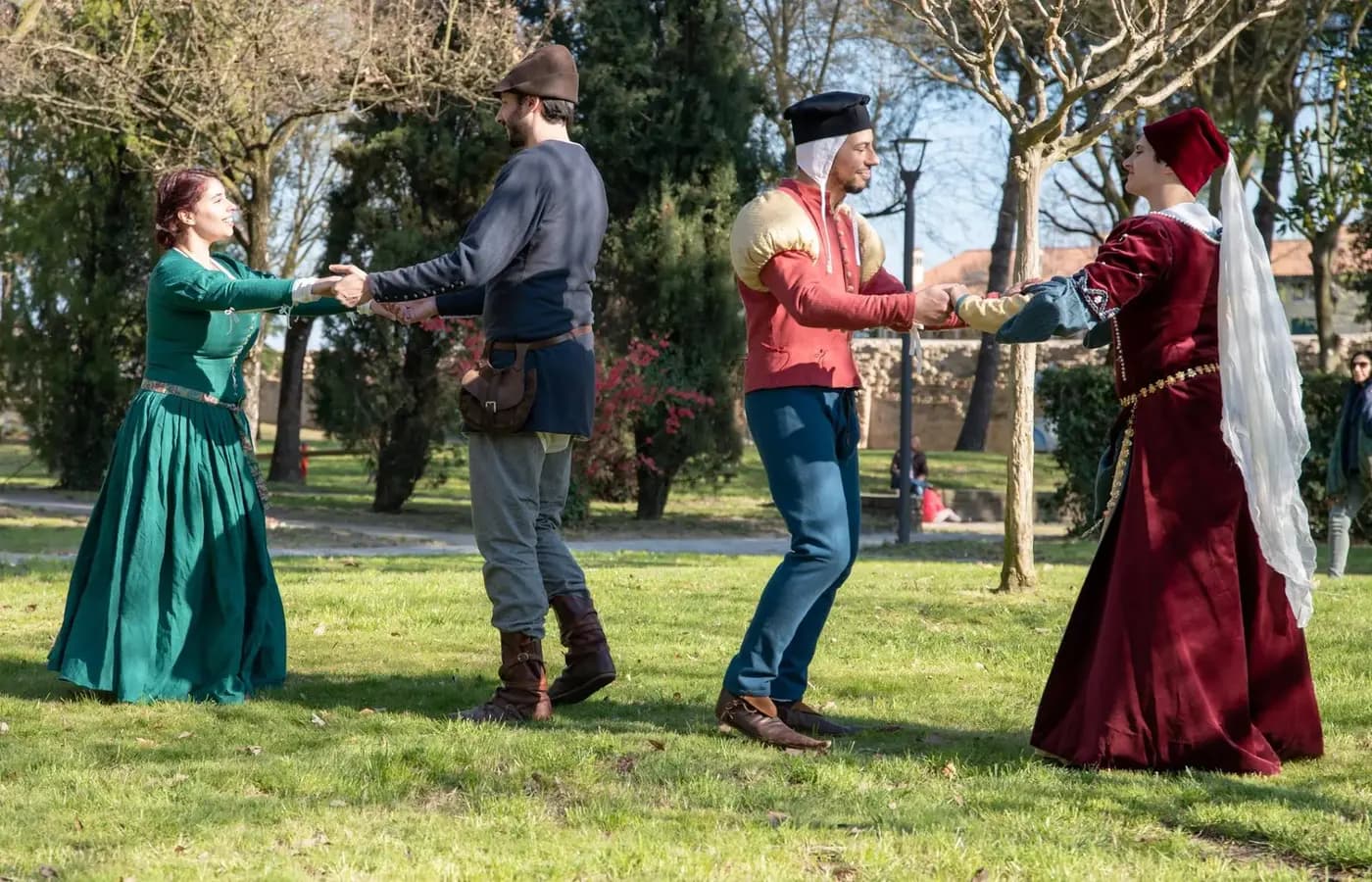
Dancing between the Middle Ages and the Renaissance is not just a pastime or entertainment, it is a playful expression and above all a courtship technique. In the geometric choreographies, in the rhythmic correspondence of music and steps, in the fine movements, there is all the poetry and concreteness of the Renaissance. The courtly and noble environment hosted refined social dances, the favourite pastime of the elite, always careful to keep up to date with the fashion of the time.
Thus appeared the first manuals of the great Italian masters of the time, such as Domenico da Piacenza and his students Guglielmo Ebreo da Pesaro and Antonio Cornazzano.
With the advent of Humanism, dance was revalued to the point of being compared to an art form, a distinctive sign of the noble classes. Starting from the carola, which alternated the forms of the circle and the chain, on the one hand, the saltarello developed as a symbol of the explosion of popular dance, while the bassadanza became the symbol of court ceremonies. In France, people danced through the "branle", chain or circle dances with the introduction of skipping steps, which were usually used to open parties, because they give guests the opportunity to get to know each other, start talking by holding hands and begin these simple dances.
Furthermore, the group deals with the study of English dances described in the "English Country Dances" of 1651, which collects almost a hundred dances that had already conquered society in the previous century.
On every occasion, the association tries to transmit to the public its knowledge learned from the study of treatises by the masters of the time and invites anyone who wants to interact in the moments of animation to dance and have fun with them!